
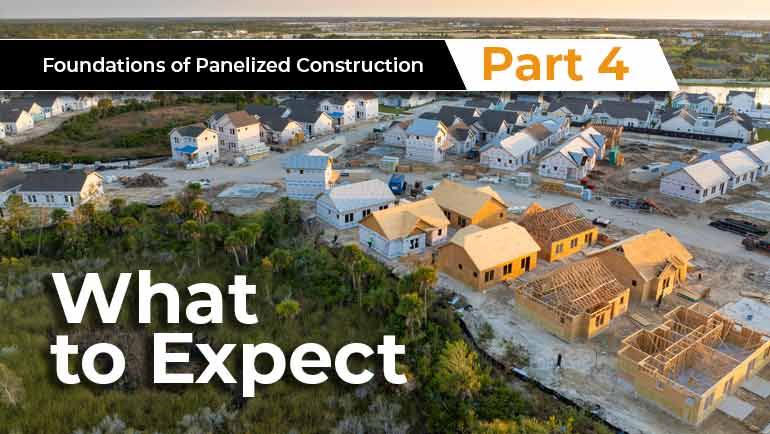
What to Expect from Production Output with Semi-Automated Panelizing
When you first consider using panelized construction equipment for producing wall panels, you might experience some hesitation with this new way of building, mainly because it’s different from what you’ve been doing manually for decades. Sure, panelizing with semi-automated equipment results in better material usage, shorter project turnaround times and more streamlined workflows, but what can you really expect in terms of your individual production output when compared to traditional panelizing?
We’ll answer these questions as the next step in our Foundations of Panelizing Construction blog series, where we’ll zoom in on production output with topics that cover how to set realistic goals with automation, how to incorporate semi-automated panelizing into your production flow and how to apply a modular approach that works for you.
Setting realistic expectations for automation and output
At Panels Plus, we don’t believe that automation means robots do all the work. To us, automation encompasses a broad spectrum of technologies – from nailing tools that fire automatically instead of a worker swinging a hammer all day to stations specifically for the application of sheathing to wood wall panels for better consistency – that increase the output of your workforce.
By design, the majority of our machines fall under the “semi-automated” category – not fully autonomous, but not fully manual. We build our systems to scale for your business to ensure measurable output improvements without an overengineered solution. For instance, one of our customers produces an impressive 1,300 lineal feet of sheathed wall panels per day using Panels Plus equipment.
Throughput benchmarks: what’s typical for your facility?
Production output is often directly tied to shop size and workflow layout. Smaller shops will naturally have smaller outputs, and that’s okay. The key is to understand where your current production needs lie, then design your lineup/layout to meet those needs. Are you a third-party vendor? Are you building your own structures? Are you short on skilled labor?
Answering these questions and checking the boxes on what is necessary to gauge your success, whether it be achieving better precision and repeatability within your panelizing, cutting down hours of labor or saving on scraps (and therefore, saving on cost), will give you the best chances for securing your throughput goals.
Keep in mind: there are no universal throughput benchmarks. Every facility is different, so careful evaluation of your specific operations is essential when planning and optimizing your setup.
Taking a modular approach
For companies new to panelizing construction, we recommend starting out by reviewing your current production needs and thinking ahead for future growth. This will help determine what type of equipment you should start with to optimize your space and machinery. Once you’re ready to grow further, you can easily add more of our new and updated manual and semi-automated equipment.
Our systems are modular and flexible, allowing you to build up for long-term growth and adapt to change. For instance, you can start with our 2 table line and expand into a 3 table line as production demands increase.
Whether you’re running a small shop or larger-scale operations, the key is to align your level of automation with your current production output goals.
Do you still have questions about switching over to panelizing equipment? Panels Plus understands and can help. Panelizing represents a major shift from traditional, stick-built methods that have worked for decades to something completely out of left field. However, as demands are changing in the construction industry, the right approach – and a partner like Panels Plus – will ensure that you don’t have to figure out the shift alone.